MotoGP engines' hidden lives and cold start techniques are being examined in motorsports. In this section, we will discuss how MotoGP engines operate, the tolerances between the piston and cylinder, the expansion aluminum exhibits against steel, and the procedures implemented by engineers.
The Hidden Life of MotoGP Engines
The operating principles and safety risks of MotoGP engines are addressed. A MotoGP engine is never started in the paddock by turning the ignition switch. The engine is first heated externally, then turned by an external unit, and only then handed over to the rider. The reason for this method is often misunderstood; the parts are not as tight as they would be when cold, and the clearance between the crankpins is greater than normal. In this section, we investigate where the real danger lies, the race against expansion of aluminum against steel, and the health report extracted from the oil after the race.
Is There a Starter Motor in MotoGP Motorcycles?
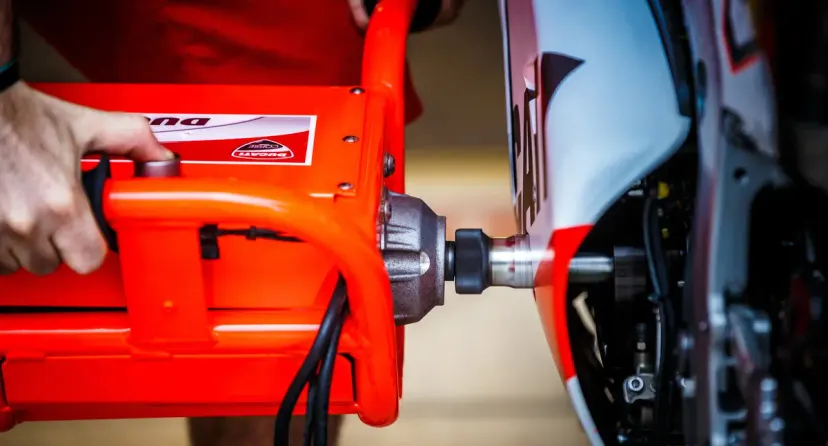
There is no starter motor in MotoGP motorcycles; this saves weight. The battery and cables are considered unnecessary because they will not be carried on the prototype race motorcycle, and the engine is only run in the paddock on weekends. Instead, teams use an external unit called a paddock starter. Two electric cylindrical rollers are placed under the rear wheel of the motorcycle. When the mechanical clutch is engaged, the rollers are run, the motorcycle is connected to the gear, and when the clutch is released, the rear wheel rotates the crankshaft via the chain. When the engine fires, the clutch is engaged again, and the motorcycle is pulled out by the unit. This arrangement has a direct consequence on the track; if the rider stops the engine, they cannot restart it because there is no equipment to turn it. A stall after a fall usually means the race is over there. Mechanics prefer to run the engine once in the paddock and not to stall it during the session.
The Real Danger is Not Cold, But Gas
Not starting race engines when cold is often explained as "parts fit tightly." However, the mechanism shows the opposite. The clearance between the piston and the cylinder is determined according to the operating temperature of the engine. Therefore, when the engine is cold, the piston remains relatively small compared to the cylinder, and the gap is greater than the design value. The danger arises the moment the cold engine is loaded. Since the piston remains inside the combustion chamber, it heats up very quickly and expands. The cylinder wall receives heat from the piston through the seals, and this transfer proceeds much slower. If the piston expands too much, the excess gap closes within seconds, and the event called "cold squeeze" occurs. Consequently, it can lead to the piston seizing in the cylinder. Comparing race engines with series production engines highlights this risk due to the much tighter tolerances in race engines. To eliminate this difference, a preheating procedure is performed.
Aluminum Expands Three Times More Than Steel
The issue is that two different materials show different responses. Aluminum piston alloys are found in the 20-21.5 µm/m·K range of thermal expansion coefficient. In martensitic stainless steel, this value is around 11 µm/m·K. Kevin Cameron states when speaking about motorcycle race engines that aluminum expands about three times more than iron with heat. The racing piston complicates this further; weight is constantly reduced. Honda records in its technical archives that the piston weight dropped from 147.0 grams to 122.4 grams in the development of the RC211V, and the number of seals decreased from three to two. A lighter piston heats up faster, and the reduction in the number of seals makes heat transfer to the cylinder more difficult. Therefore, every step that increases the engine makes cold starting riskier.
How Hot is the Engine Heated?
Manufacturers of MotoGP engines specify the target temperatures for the engines. It is known that the engine is heated by external systems and not by letting it idle in the cylinder. Exact figures are not shared due to competition, and this information provides a direct advantage to manufacturers. In a Formula 1 engine contract, a condition is stipulated that the engine cannot be run before oil and coolant reach 80 degrees Celsius. The process of circulating coolant with an external heater and pump in DTM takes about 20 minutes. Although there are no MotoGP figures, this shows the importance of the procedure. The effect of cold oil: Pressure does not drop; it rises. Racing teams use very thin oils to reduce friction and gain power, preferring 5W30 to 0W30 grades on the grid. Cold oil behaves thick and struggles to pass through narrow channels with the pump. This resistance reverses the expectation of most riders. Oil pressure does not drop when cold; it rises. The pressure overflows the overflow valve, but the thick oil cannot supply the moving parts fast enough at high RPM. The oiling gap and the resulting heat increase are caused by the second factor of cold squeeze risk. Engine internal health report: Metal in the oil. A common monitoring method in racing engines is the spectrometry of the oil. Microscopic metal particles in the oil are measured, and each metal indicates a different area. Aluminum is mostly caused by the piston ring exceeding the cylinder, iron by the cylinder block, and copper by the bearing exceeding. This method allows reading the internal condition without dismantling the engine. It is not disclosed how often MotoGP teams apply this method, but it is known that this method is standard in motorsports and aerospace. For piston engines in aerospace, aluminum exceeding 30 ppm and iron exceeding 100 ppm is considered high. These figures are not MotoGP limits, but a benchmark showing how precise the method is.
Why Is This So Important: The Eight-Stroke Season
The reason for all this meticulousness lies in the four-stroke system explained in the first section. Ducati, KTM, and Aprilia riders have to complete a season with an eight-stroke engine. Yamaha and Honda can use ten engines within the category. All these numbers are sealed and cannot be opened during the season. An engine lost due to a single mistake in the paddock is a lost asset that cannot be recovered. This is why the preheating procedure is not a matter for negotiation for mechanics. In the next section of our article, we will delve into the micro-engineering inside the engine. How do pneumatic valve springs enable reaching 18,000 rpm? Where do DLC coatings and exotic materials that reduce friction fit into this equation?
With Figures
- Archive: The Championship Struggle in MotoGP at a Critical Point (September 29, 2026)
Read the full story at the original source.
Go to sourceCompiled by Şükrü Utku Poyraz