AI Assisted Journalism
This article has been researched, summarized, and uniquely written by our AI editorial system based on information from Speedweek MotoGP.
MotoGP Catalunya GP: Controversial Collisions at Turn 1!
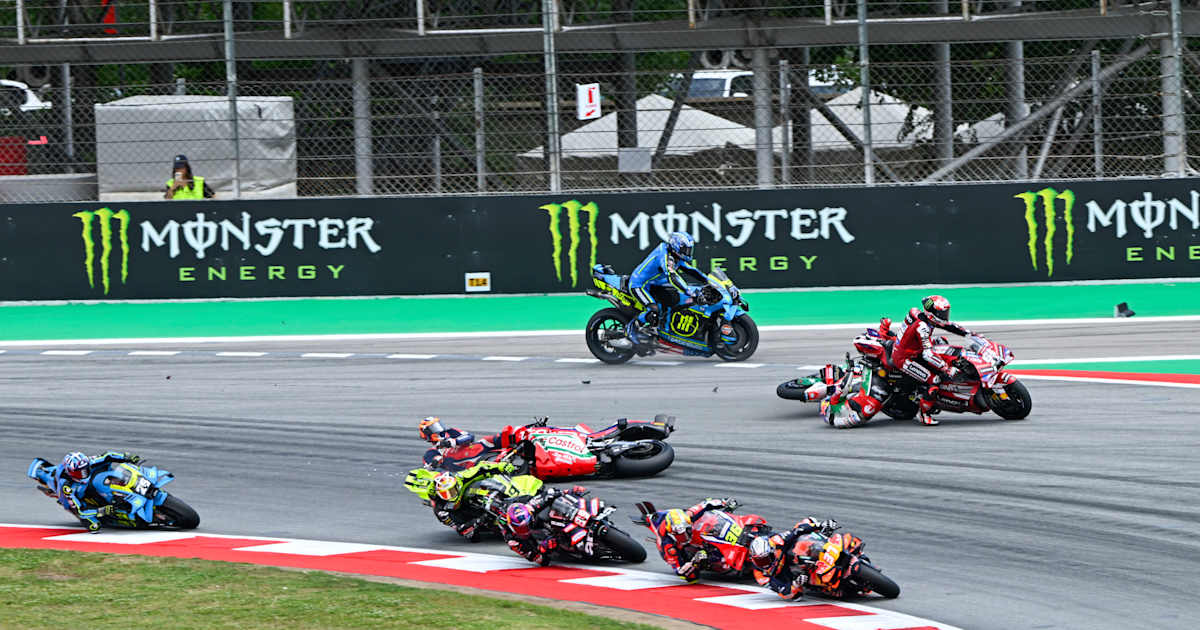
…The end of the MotoGP Catalunya Grand Prix turned out to be, contrary to expectations, not just a race, but also a dangerous incident. The chain-reaction crash at Turn 1 caused riders to lose control and completely altered the course of the race. Johann Zarco, Luca Marini, and Francesco Bagnaia sustained serious injuries as a result of the crash. This raised important questions about the future of the race and the safety of the riders.
Causes and Details of the Crash
The crash quickly resurfaced at Turn 1 in a controversial manner, even after the race restart. Johann Zarco lost control while entering the corner on his LCR Honda and collided with Luca Marini’s RC213V. This impact also led to Francesco Bagnaia’s (Ducati) chain fall. Zarco became trapped inside the rotating wheel of the Ducati, being thrown into a pile of sand. Marini and Zarco, rushing to assist the injured Zarco, witnessed the French rider’s helplessness.
Post-crash initial assessments revealed that Zarco had fractured his left leg and suffered leg dislocations with significant damage to the ligaments surrounding his knee. It was estimated that Zarco would be unable to race the next two Grand Prix due to these injuries.
Technical Challenges and Hazardous Zone
The crash once again brought to light the problems created by Turn 1, one of the most dangerous areas of the track, which is MotoGP’s most extreme braking zone. According to Brembo engineers, braking from 338km/h to 100km/h over a distance of 250 meters is one of the most extreme braking zones on the MotoGP calendar. At the start-finish line, motorcycle speeds reach approximately 360 km/h, while at Turn 1, they must reduce to approximately 100 km/h in about 4.6 seconds. This braking distance is already quite dangerous even in a normal race.
Aerodynamic Effects and Increased Risk
This situation is exacerbated, particularly in the early stages of the race, when 22 motorcycles pass each other, tires are cold, and maximum pressure is applied. In particular, the aerodynamic effect of a leading motorcycle can cause instability in following motorcycles. This “dirty air” effect poses a significant risk, especially for riders in the middle of the pack.
Fabio Di Giannantonio, after the crash with Brad Binder and Joan Mir in the sprint race last Saturday, stated, “The risk of entering other riders’ space increases when riding near the limit.” Aerodynamic developments in previous years have further increased this risk.
A Historical Problem: The 2006 Crash
Turn 1 has experienced many crashes in MotoGP history. The 2006 crash between Sete Gibernau and Loris Capirossi was one of the most spectacular crashes at Turn 1. The Werks Ducati pilots collided while braking in the corner, with Gibernau completely overturning and flying into the air. This caused a chain reaction involving four other riders. Marco Melandri fell unconscious onto the track, and Capirossi was taken to the hospital by helicopter.
2022’s Takaaki Nakagami Fall
The same problem reappeared in 2022 when Takaaki Nakagami collided with Pecco Bagnaia’s Desmosedici behind. Nakagami put his head into his helmet and spent a night in the hospital. Alex Rins also left the race with a fractured wrist.
Rider’s Request for a Solution
Following this incident, the riders again requested the modification of the starting grid at Turn 1. This should be considered a structural change, and regulations should be implemented regarding how the starting positions are arranged. Work should also be done to reduce aerodynamic effects. The impact of these changes is yet to be seen with the new rules in 2027.
Yorumlar (0)
Bu tartışmaya katılmak için giriş yapmalısın.
Henüz yorum yapılmamış. İlk yorumu sen yap!